
A Japandi style bedroom is low, quiet and warm: a low wood platform bed, linen in two or three soft tones, warm light from a lamp or paper shade, and almost nothing on the floor. A Japandi living room runs on the same rules, with a low sofa, a solid wood coffee table and closed storage. Below you'll find the palette, the furniture rules and what to remove first, with the main rules shown in two ordinary rooms. Room Redo is an iPhone app that redesigns a photo of your own room in the style you pick, and your first redesign is free.
At a glance
- Palette
- Warm white, sand, clay, sage
- Wood
- Light oak or walnut, one main tone
- Furniture
- Low, few and solid
- Light
- Warm bulbs, paper shades
- First step
- Clear the floor and every surface
What is Japandi style?
Japandi is a mix of Japanese and Scandinavian design: warm minimalism, natural materials, low furniture and very few things. The name emerged around 2016, and it draws on two ideas, the Japanese wabi-sabi (beauty in imperfect, handmade things) and the Danish hygge (feeling cozy at home).
The link is much older than the name. Scandinavian designers and artists began visiting Japan in the mid-1800s, after the country opened its borders, and many came to admire Japanese craft and design.
In a real room, it comes down to seven rules:
- Warm minimalism: fewer things, but soft and used. Spare, never a white box.
- Natural materials: one main wood tone, from light oak or ash to walnut, plus a contrasting wood or black accent or two. Linen, cotton and wool for fabrics. Paper, ceramic and stone for the small things.
- Low furniture: beds, sofas and tables sit close to the floor, which makes the ceiling feel higher.
- An open floor: leave walking space around every piece. Bare floor is part of the look.
- Closed storage: drawers and doors, not open shelves full of stuff.
- Handmade over perfect: a lumpy ceramic lamp beats a glossy one.
- A few plants: one big plant with a strong shape, maybe two small ones. Not a jungle.
What colors are Japandi?
Japandi colors are warm neutrals (warm white, greige and sand), earthy accents like clay and muted sage, and a little charcoal or black for contrast. Here's where each one goes.
| Color | Where it goes | How much |
|---|---|---|
| Warm white | Ceiling and most walls | The base of the room |
| Greige or sand | One wall behind the bed or sofa, bedding, upholstery | Plenty |
| Natural wood | Bed, tables, dresser | Plenty |
| Clay or terracotta | Cushions, a ceramic lamp, plant pots | Small touches |
| Muted sage | A throw, one cushion, the plants themselves | Small touches |
| Charcoal or black | Picture frames, a lamp base, a stool | One or two pieces |
Warm undertones matter more than the exact shade. Cool grey next to pale oak makes the wood look orange and the room feel cold. A warm white or sand wall picks up the wood instead.
Before you paint, put a sample patch right next to your floor or bed frame. Look at it at night under your own bulbs, not only in daylight.
How to set up a Japandi style bedroom
Start with the bed, then take things away until the room goes quiet. These are the rules for a Japandi bedroom design:
- A low platform bed in light to mid wood. Skip the tall tufted headboard.
- One simple nightstand, or none. One lamp and one small object on it.
- Hidden storage: a dresser with drawers, closed boxes under the bed. Nothing lives on the floor.
- Layered bedding in two or three tones, such as white linen, a sand duvet and a chunky oatmeal knit.
- Low, warm light. A paper lantern or a ceramic lamp, with bulbs around 2,700 K. The US Department of Energy calls that warm light that suits the wood finishes and fabrics in homes.
- One large artwork per wall, or none. Skip the gallery wall: the bare wall around the piece is part of the calm.
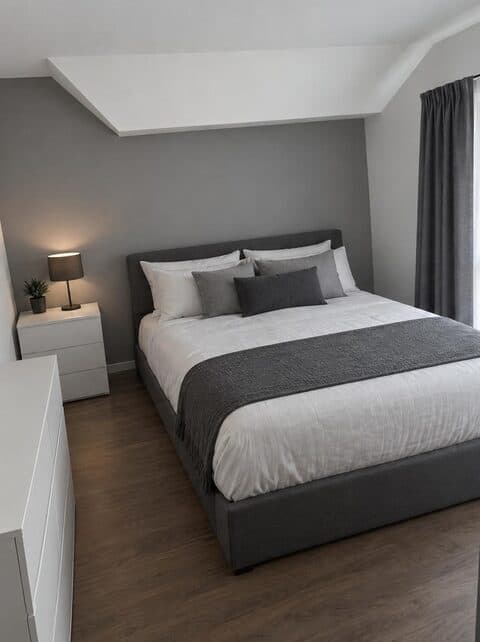
Here's what those rules do to a real room. This attic bedroom has a sloped ceiling, a loud tropical wallpaper wall, a drying rack piled with laundry and clothes on the floor. Drag the slider to compare it with the Japandi redesign from Room Redo.
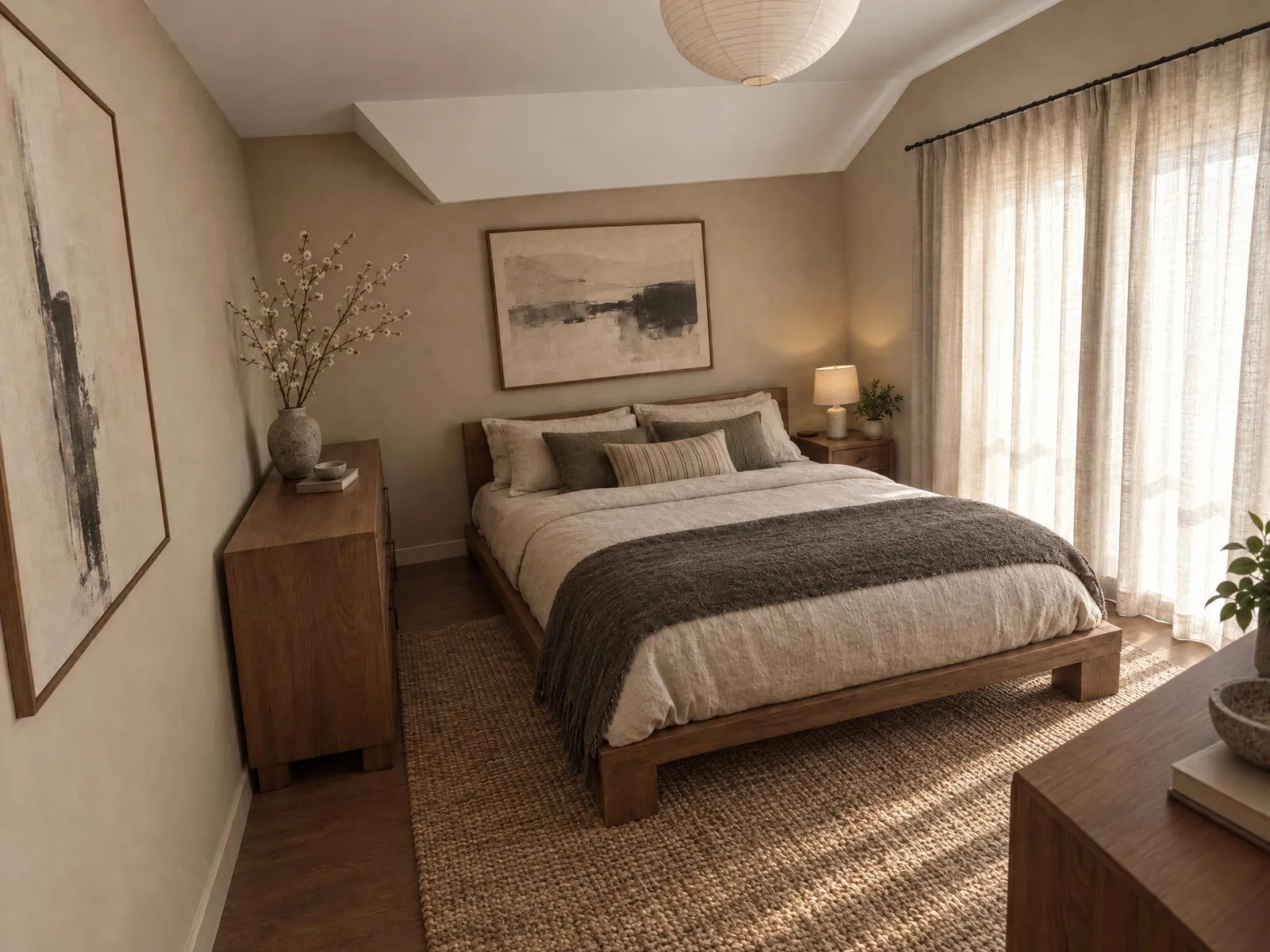
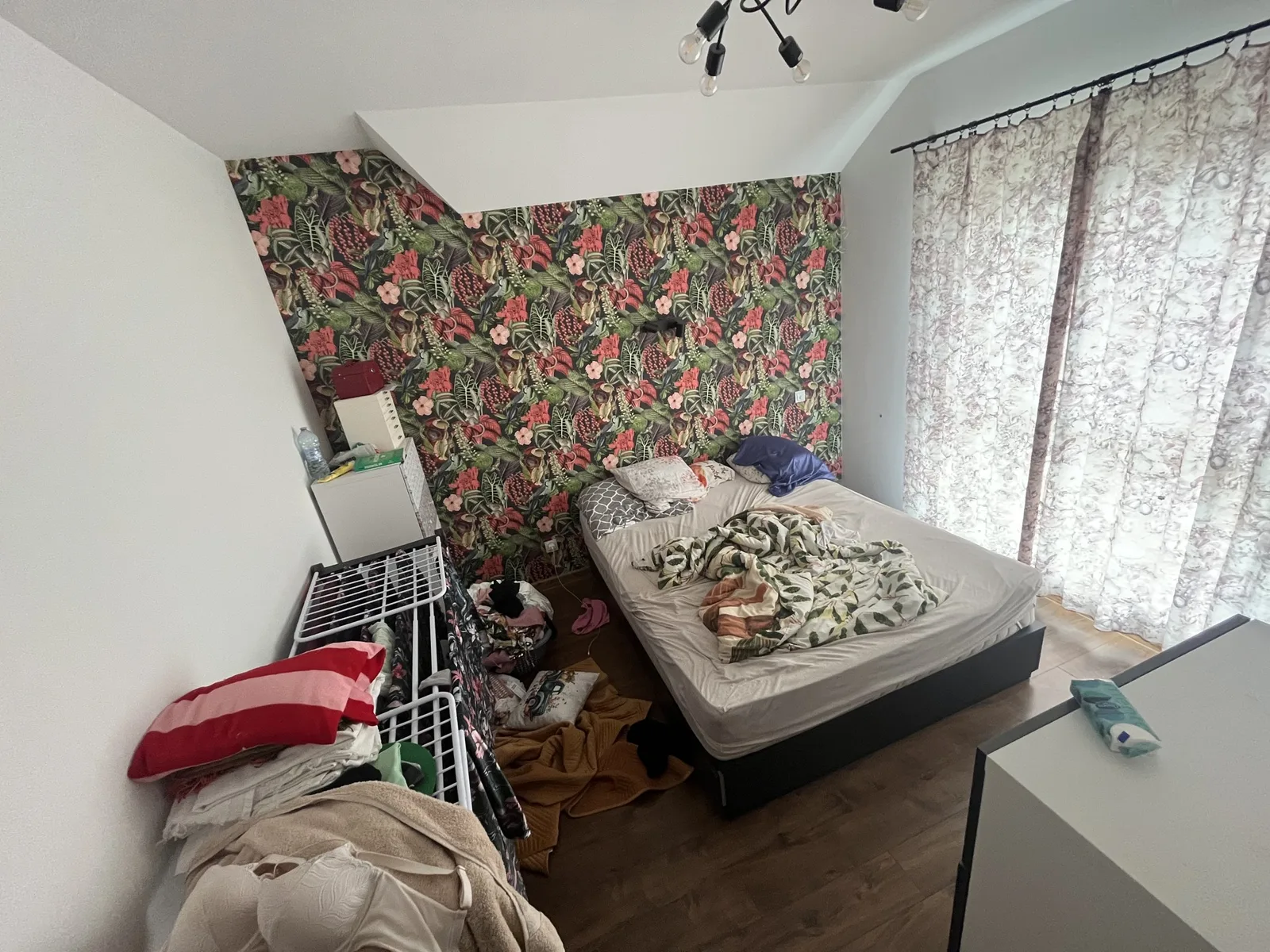
Each change maps to one of the rules above.
| What changed | The rule behind it |
|---|---|
| Floral wallpaper and white walls became warm plaster-beige walls | Warm neutrals, no loud pattern |
| The black bed frame became a low walnut platform bed | Low, solid furniture |
| The drying rack and laundry gave way to a walnut dresser with drawers | Closed storage |
| Clothes on the floor gave way to a chunky jute rug | An open floor |
| Mixed print bedding became linen with sage and striped cushions and a dark knit throw | Two or three tones, lots of texture |
| The black multi-arm ceiling light became a round paper lantern | Low, warm light |
| Patterned curtains became sheer linen on a black rod | Natural materials, one black accent |
| The small white cabinet with clutter on top became one walnut nightstand with a lamp and a small plant | One lamp, a few plants |
| Two large ink-wash prints, one over the bed and one on the side wall | One big piece per wall, no gallery |
In this result the window, the sloped ceiling, the bulkhead and the wood floor are all still there. The white dresser in the foreground is walnut now.
The redesign chose walnut, not light oak, and walnut works in Japandi too. Pick one main wood tone and keep the walls warm and the fabrics pale, so the wood has something to stand against.
None of these changes needs a builder. In your own room, paint, a paper shade over the bulb, sheer linen curtains and a rug do most of the work, and together they cost far less than a new bed.
Japandi living room: layout and rules
A Japandi living room is built around one low sofa, one solid wood table and a rug that marks where you sit. Everything else is optional.
- A low sofa in linen or boucle, in oatmeal, sand or warm white.
- A solid wood coffee table, chunky and plain.
- One low armchair or a couple of poufs, not a matching set of armchairs. Fewer seats keep the view across the room open.
- One large plant with a strong shape, such as a fiddle-leaf fig, plus one or two smaller ones.
- Sheer curtains in linen or cotton, hung close to the ceiling.
- A rug big enough to hold the sofa and the table, so the seating reads as one zone.
- A low sideboard with doors for everything else.
This next room is a half-renovated living room in an older city apartment: bare pine floorboards, two tall windows over radiators and a brass chandelier, plus a cable reel and a few tools on the floor.
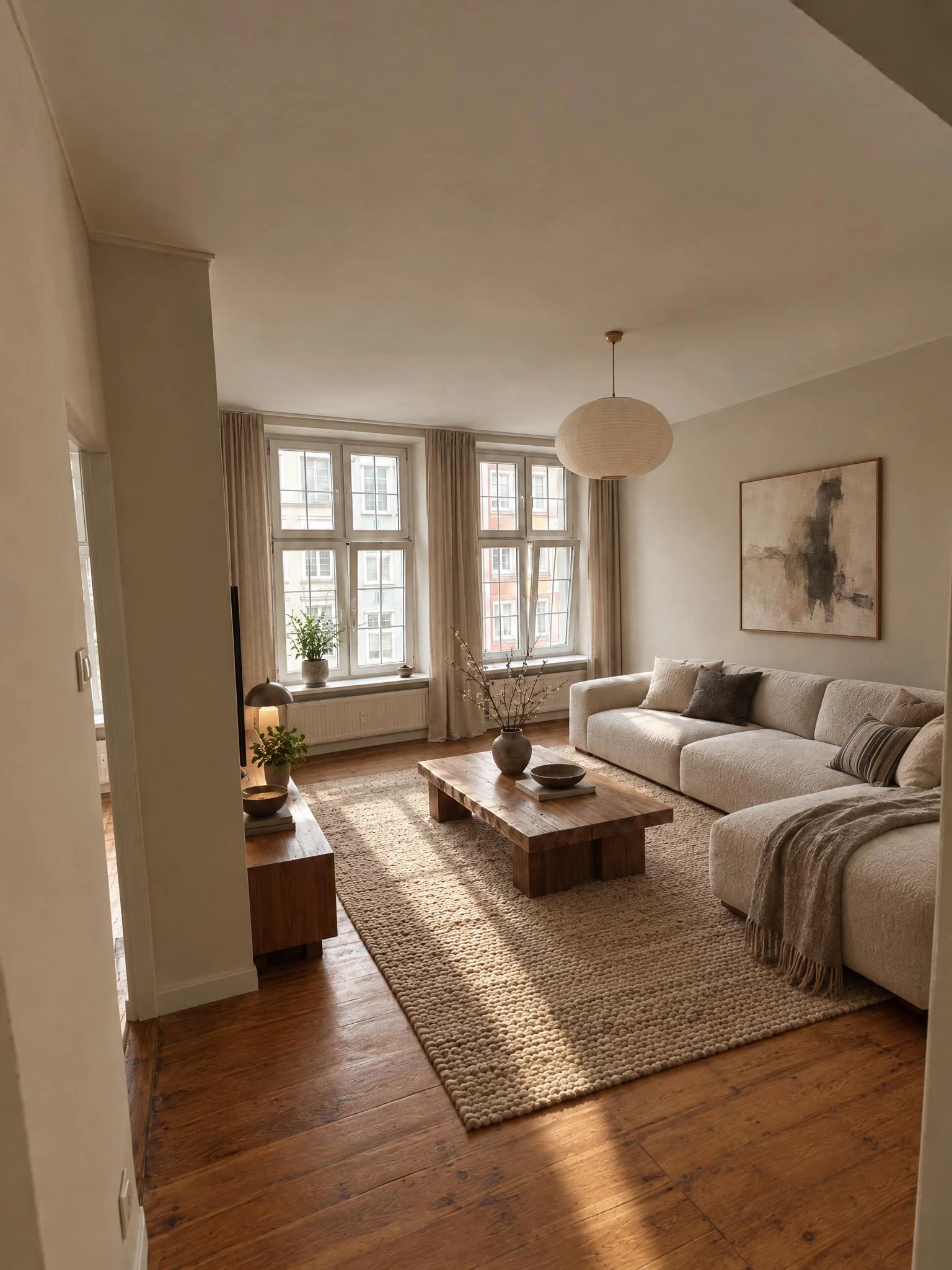
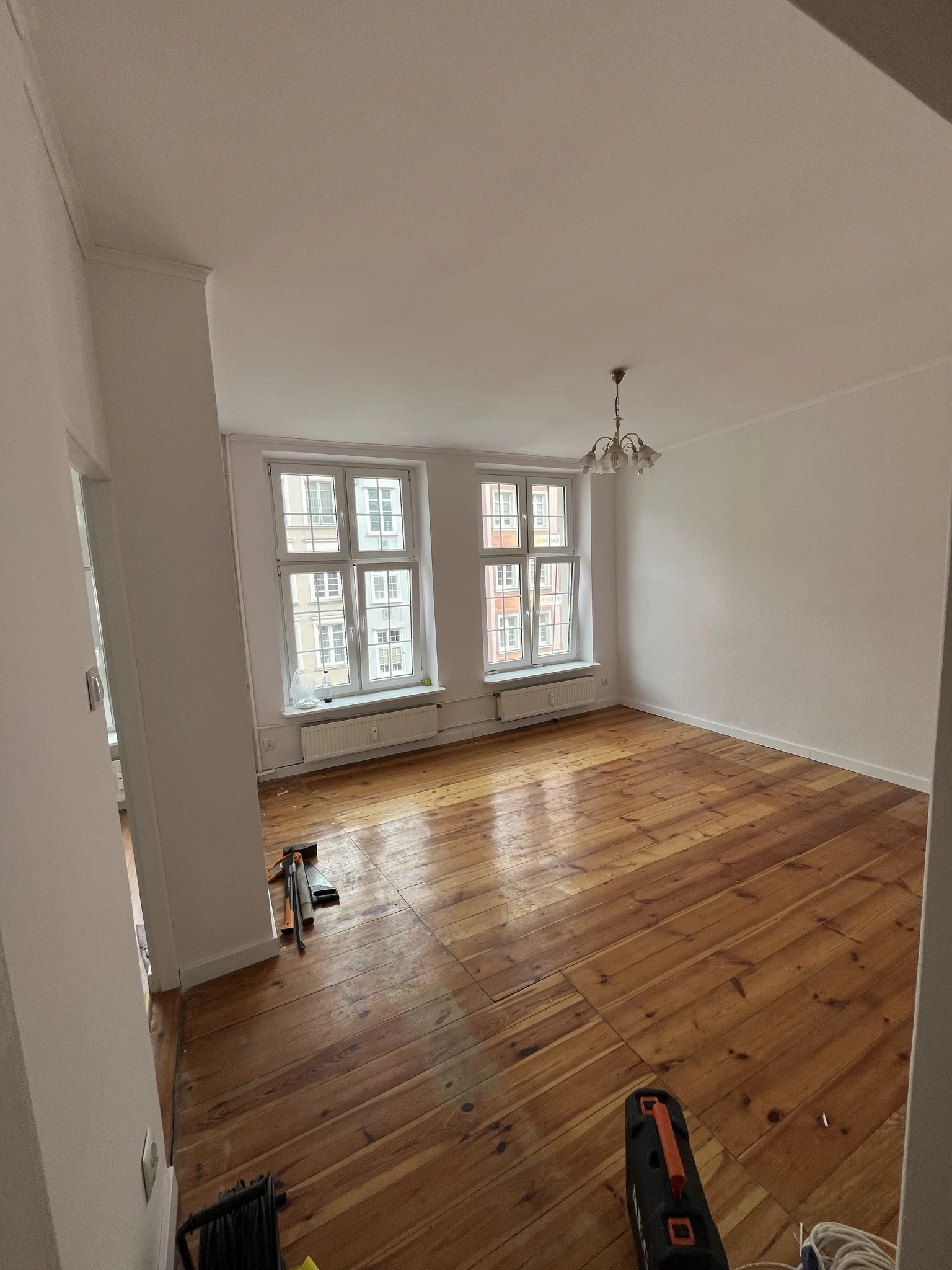
In this result a low cream boucle L-shaped sectional runs along the right wall, with cream, charcoal-brown, striped and tan cushions and a fringed throw over the chaise. In front sits a thick reclaimed-wood coffee table on block legs, holding blossom branches, a wood bowl and books. A chunky woven wool rug under both makes one zone, and a large abstract artwork in charcoal and sand hangs over the sofa. There is no armchair: the chaise is the extra seat, so the floor stays open.
Look at the wood: the coffee table and the low sideboard by the pillar share one warm mid-brown, so the room reads calm even over an orange pine floor. In your own living room, pick one main wood tone, from light oak to walnut, and repeat it rather than mixing four.
The brass chandelier became a round paper lantern, and the windows got full-height linen curtains. A mushroom lamp on the sideboard adds lower light, and a plant sits on the left sill. The tools and cable reel are gone, and the floor around the furniture is clear.
In this result the pine floor, the two windows, the radiators, the doorway and the pillar are all there. The orange floor is a useful lesson: if your floor is a strong orange wood, a big neutral rug and pale upholstery calm it down, so you don't have to refinish it.
Is Japandi the same as Scandinavian?
No. Japandi is lower and quieter, with darker accents. Scandinavian is brighter and a little fuller.
| Feature | Japandi | Scandinavian |
|---|---|---|
| Palette | Warm white, sand, clay, sage, charcoal accents | Bright white, light grey, soft pastels |
| Wood | One main tone, light oak to walnut, plus black accents | Pale wood throughout |
| Furniture | Low, close to the floor, solid | Standard height, often on slim legs |
| Pattern | Almost none; texture does the work | Stripes and simple prints on cushions |
| Mood | Calm and spare | Bright and lived-in |
Here's the same living room in both styles. Tap a style, then drag the divider.
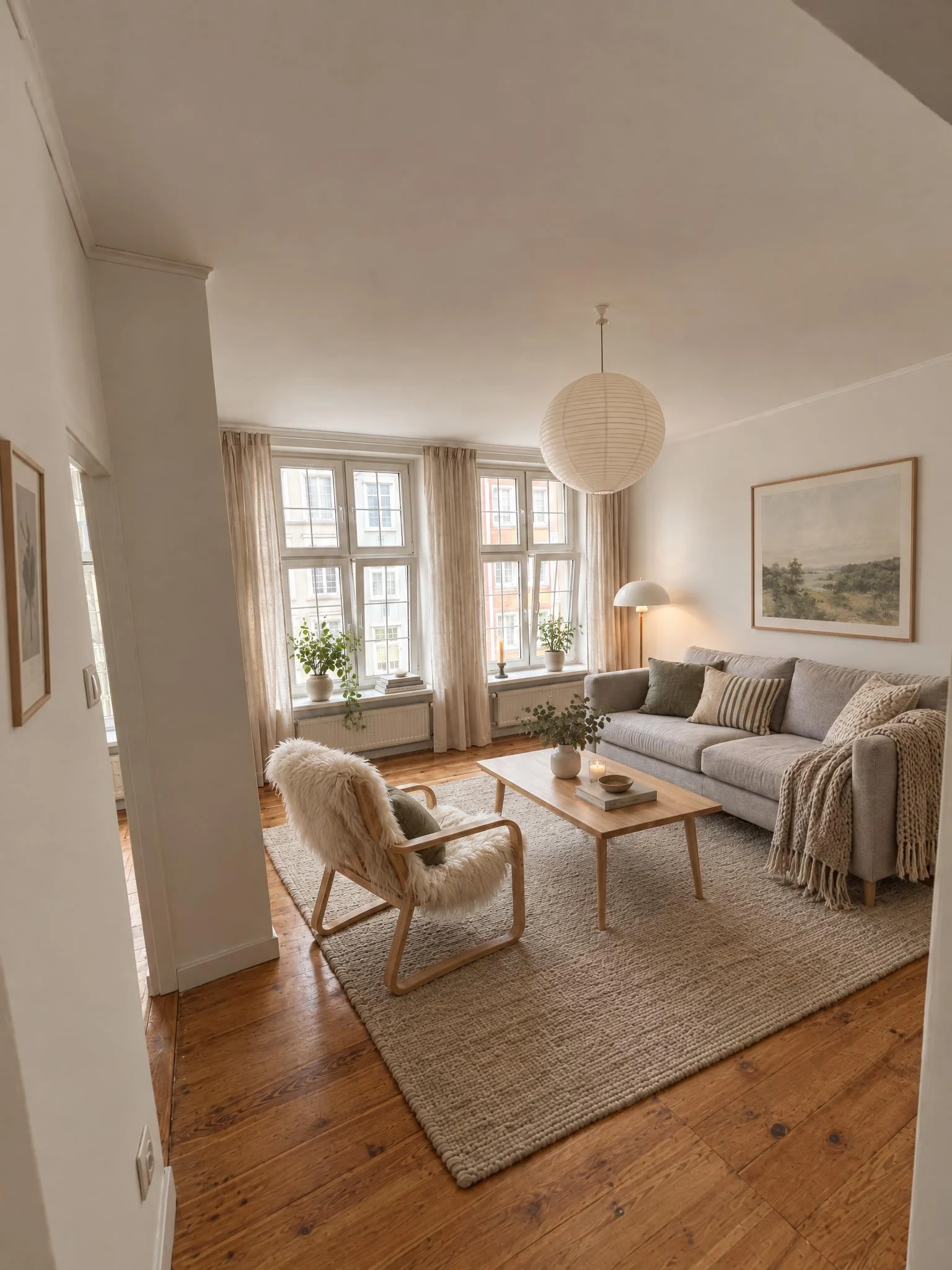
Same room, different feel: in both results the sofa sits on the right wall, and the floor and windows are the same. The Scandinavian version has whiter walls, a light grey sofa on slim legs, a pale oak table on tapered legs, a bentwood birch armchair with a sheepskin, a white dome floor lamp and a soft landscape painting. The Japandi version runs warmer, lower and heavier: greige walls, a cream boucle L-shaped sectional instead of a sofa and armchair, a thick reclaimed-wood table on block legs, a solid-wood sideboard with a mushroom lamp and one large abstract artwork in charcoal and sand, with fewer separate seats and more open floor. Both hang a round paper pendant and use a chunky wool rug, which shows how much the two styles share.
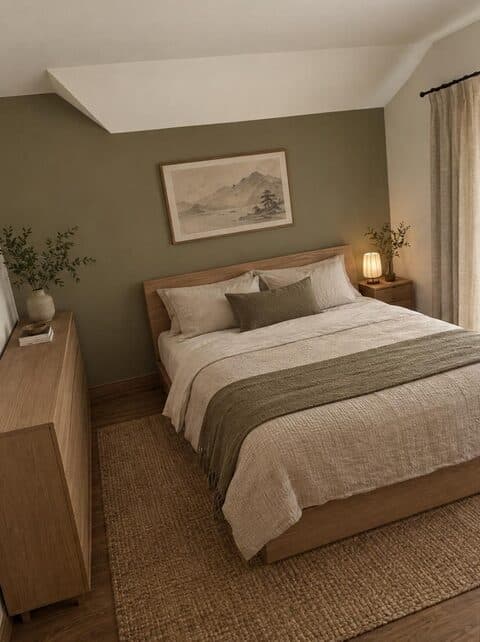
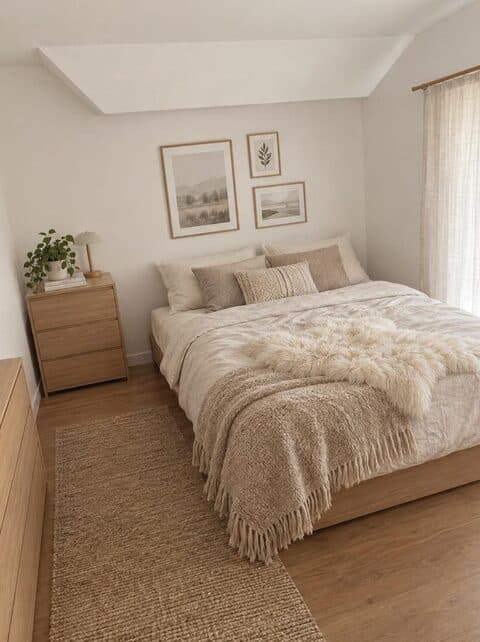
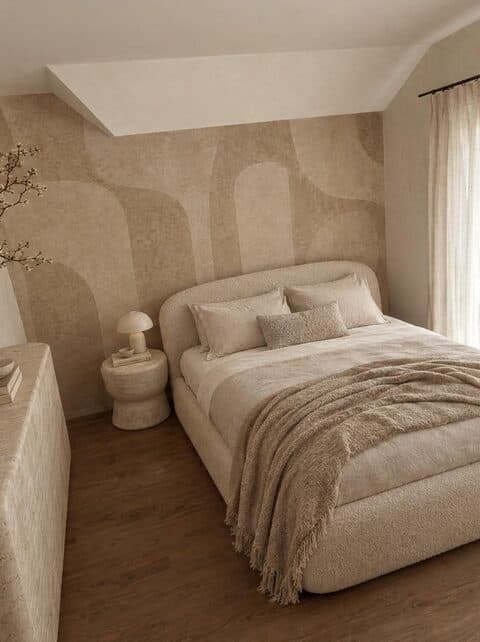
These four styles share the Calm & Minimal group in Room Redo. If you're torn, the Room Redo style wall shows each one applied to the same cluttered bedroom, so you can compare them side by side.
Can I make a small bedroom Japandi?
Yes. Japandi suits small bedrooms well, because its main move is taking things out.
- Keep furniture low so your eye travels over it. A clear line at eye level makes the room read bigger.
- Pick a bed with storage underneath, or slide closed boxes under it, and drop the second nightstand.
- Paint the walls one warm white or sand so the corners blur.
- Hang a mirror beside or across from the window so it bounces daylight around.
- Use a wall light or a pendant instead of a floor lamp, to free up floor space.
- Keep all the textiles in one color family.
The attic bedroom above shows how much a small, awkward room can take. The dresser stands against the side wall, the low bed sits in the middle on a jute rug, and the floor around them stays clear.
Start this weekend: what to change first
Do it in this order. Removing things costs nothing, and paint comes last because an empty room shows you what color it needs.
- Clear the floor and every surface.Put back only what you use every day.
- Swap the bedding or sofa throw.Go for linen or cotton in white, oatmeal or sand, plus one chunky knit.
- Change the bulbs.Use warm white everywhere and switch off the main overhead light in the evening.
- Add a paper shade and one plant.A paper lantern over a bare bulb is one of the cheapest big changes you can make.
- Paint last.Do one warm wall behind the bed or sofa, or the whole room in warm white.
If you only get through the first three steps, the room will already feel calmer.
Mistakes that make Japandi look cold or themed
Japandi usually goes wrong in one of two ways: too cold, or too much.
| Mistake | Why it fails | The fix |
|---|---|---|
| Cool grey walls and bright white everything | The room feels like an office | Warm white, sand or greige |
| All blond wood, all matching | It looks like a showroom set | Add one darker wood or black piece |
| Too many objects | The calm is gone | Keep a few things you love, store the rest |
| Fans, bamboo prints and other Asian-themed props | Style turns into a theme | Let paper, ceramic and wood carry the Japanese side |
| One harsh overhead light | Texture goes flat | Lamps at low height, warm bulbs |
| Smooth surfaces only | The room feels hard | Linen, knit, jute and rough ceramic |
See Japandi in your own room first
The hard part is picturing all this in your room before you buy a bed or a tin of paint. Take a photo of your bedroom or living room as it is today, mess included, and pick Japandi in Room Redo. You can ask for things like a paper lantern or a rug, then drag between before and after. Your first redesign is free, and the guide to trying a free AI room redesign walks through how it works.
